Pages
Stay In Touch
More
© 2010 Columbia University Democrats
liveblogged by Kate O’Gorman
Hey folks!
We’ve got a room full of people, starting to get excited about the state of union. Some people have wandered in wearing their vintage 2008 Obama for President t-shirts but regardless of how people are dressed, the largest room in our student center is filled to the brim with people waiting for the address.
I hadn’t realized that the State of the Union was an event that you went early to, but 25 minutes before show time and there are no seats in the house. There is also no more pizza, and in this Dem’s opinion the new Dominos recipe isn’t much better than the last.
(9:05) We always know that Republicans tend to follow the trend rather than lead them. Now, following Nancy Pelosi’s lead today, the Republicans are responding to the State of the Union before the speech even starts. Seems sort of like a preemptive response, but perhaps they’ll argue that it was, in fact, preventative.
(9:06) The floor, and the Columbia Satow room, breaks out in applause as President Obama is announced. Now… we’ll take a 20 minute applause break as we take a moment to watch Obama shake the hands of 535 people…
(9:11) President Obama is starting his speech – took a lot less time than I thought it might!
(9:16) “the numbing weight of our politics.” Thank you to President Obama for reminding us of the common goals and hopes that we have regardless of our politics. In my own discussions with Republicans, it isn’t as though we aren’t working for a better American future. We just have different ways to get there. Please, Congress, remember that as well.
(9:17) “It is time the American government gets a government that matches their decency”…. Biden was a little too enthusiastic on the clapping there. So was the rest of the Columbia watch party. I think that the room may be more entertained by Vice-President Biden than the speech.
(9:25) Job must be our #1 focus – gets the first standing ovation from both sides of the asile tonight. We should start in new small businesses (this means we need health care folks…)
(9:30) Second bipartisan standing ovation – take tax credits. Then ensued the House vs. Senate cheering contest. Despite their lower numbers, I’d say the Senate wins (Can we get that kind of enthusiasm for passing legislation?).
(9:32) I will not accept second place for the United States of America (Preview of the olympics?). Slowing down policy only allows other countries to catch up, Obama argues. Moves quickly to the dire need of financial reform. House has passed it, Senate now needs to pass it. I can’t think of a more important issue right now.
(9:36) “and I know that there are those who disagree with the overwhelming scientific evidence on climate change. But even if you doubt the evidence, providing incentives for energy efficiency and clean energy are the right thing to do for our future – because the nation that leads the clean energy economy will be the nation that leads the global economy. And America must be that nation.” Loudest cheer from Columbia thus far erupts in the Satow room
(9:42) “And let’s tell another one million students that when they graduate, they will be required to pay only ten percent of their income on student loans, and all of their debt will be forgiven after twenty years – and forgiven after ten years if they choose a career in public service.” As may be expected from a college watch party, we had our first group of people standing up this year.
(9:45) First Lady Obama tells everyone to “Sit Down.” President Obama says she gets embarrassed.
(9:48) This room is wondering why the Republicans give a standing ovation when Obama solicits other strategies to health care reform. Have they proposed a plan yet?
(9:51) Announces 3 year budget freeze. No more tax cuts for those making over $250,000 a year.
(9:54) In the general theme of Obama laying down the law on the Senate, Obama announces an executive commission that the Senate has said no to
(9:57) “To do that, we have to recognize that we face more than a deficit of dollars right now. We face a deficit of trust – deep and corrosive doubts about how Washington works that have been growing for years. To close that credibility gap we must take action on both ends of Pennsylvania Avenue to end the outsized influence of lobbyists; to do our work openly; and to give our people the government they deserve.”
(10:01) New title for the State of the Union: Senate Smackdown
(10:03) “Just saying no to everything may be good short-term politics, but it’s not leadership. We were sent here to serve our citizens, not our ambitions. So let’s show the American people that we can do it together.”
(10:12) Aside from Columbia school policy, some people are wondering why they didn’t find the State of the Union drinking game before we showed up…
(10:14) Don’t Ask Don’t Tell. It’s time to end it.
(10:18) “But I also know this: if people had made that decision fifty years ago or one hundred years ago or two hundred years ago, we wouldn’t be here tonight. The only reason we are is because generations of Americans were unafraid to do what was hard; to do what was needed even when success was uncertain; to do what it took to keep the dream of this nation alive for their children and grandchildren.”
(10:20) “We are strong. We are resilient. We are American.”
Republican Response:
Just for transparency’s sake: the Columbia University College Democrats really don’t like Bob McDonnell. He broke our undefeated record in our campaign trips as we campaigned for Creigh Deeds this semester. So, we really dislike him.
(10:34) “We want cooperation, not partisanship.” Pardon me, but I think that the Democrats have been calling for bipartisanship the whole time…
(10:35) “the GOP welcomes your ideas on facebook and twitter.” Thank you to the GOP for asking for ideas…. as long as you can fit them in 140 characters
(10:37) “A child’s educational opportunity should be determined by her intellect and work ethic, not by her zip code.”
(10:40) “Here at home government must help foster a society in which all our people can use their God-given talents in liberty to pursue the American Dream. Republicans know that government cannot guarantee individual outcomes, but we strongly believe that it must guarantee equality of opportunity for all”
The crowd here wonders if that was Governor McDonnell’s normal speech writer. It did not seem to carry the cadence he normally does. All in all, however, good speech.
- That’s all folks!
by Sam Klug
I now have a former Cosmo model as my US Senator.
Was it a referendum on healthcare? Partially. On Obama? Probably.
Was it the candidate’s fault? The state’s? The administration’s? Yeah, sure, if it makes you feel better to dole out some blame, it was a little of everybody’s fault.
But basically, this race was just a version (condensed, over-spun, nastier) of the battle we have been fighting for what seems like forever. It wasn’t about terrorist trials in civilian courts, or about the public option, or about the candidates’ genders. Of course, it was about all that, at least a little bit, because all of those issues fall within the broader conflict that has dominated American politics for the past three decades at least: the conflict between a vision of America dominated by fear and intolerance and one of gradual movement toward a more just society; between a philosophy that says government can do no good (except for the super-rich, but shhhhh) and one that hopes to turn government into a vehicle for the achievement of at least a few of our ideals.
The other side in this conflict has consistently gotten the better of us for the past thirty years. For twenty-eight years, we had eight of Democratic rule. Now we have nine, and let’s just think about this last one – since the inauguration, we’ve gotten a watered down stimulus and a root canal of a debate about health care that has led even the compromise of the public option into the jaws of the right-wing, teabagging, “get the government out of my pockets” monster. That’s it. Basically, that’s the legacy of the first year of the Obama administration and the Democratic super-majority.
So, you might ask, did we even deserve to keep the seat? Would it even have helped our country to have 60 Dems instead of 59? I don’t know about the first question (it seems you only deserve something in politics by winning it), but the answer to the second is, frankly, yes. Because if the belief that government actually can lead our society to a more just existence has any purchase anymore, we have to understand that baby steps forward are still better than leaps backward; that every vote, no matter how spineless, counts; that every victory matters. These are the lessons that Ted Kennedy learned in the Senate, and if anything positive can come from tonight’s results, for Massachusetts and for the country, it is a better understanding of these truths.
So no, Scott Brown, tonight wasn’t historic. It wasn’t new. It was a reminder, once again, of the power of the simple messages that Republicans have been spouting for 30 years. It was just a little more painful this time.
Sorry, Teddy.

Dems Vice-President, Avi Edelman, appeared on Fox and Friends to defend the current proposal for Gender Neutral Housing at Columbia. Click below to watch the full interview!
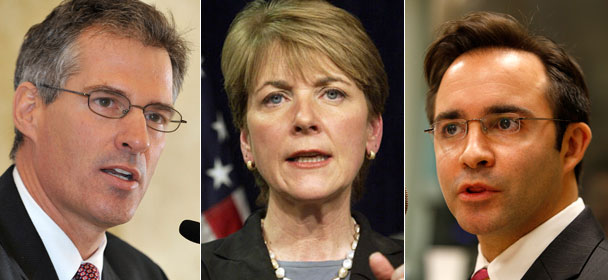
U.S. Senate Candidates from Massachusetts: Republican Scott Brown, Democrat Martha Coakley, and some irrelevant third-party candidate (Joseph Kennedy, for those of you who care...or are Libertarians)
By Helen Kilian
Since the latter half of the 20th century, Massachusetts has come to be regarded as the crux of modern liberalism in America. Consequently, it should come as no surprise that there is a relatively large constituency of CU College Dems that hail from the Bay State (or the Gay State, if you prefer; we proudly respond to either) whose members are currently—one would hope—filling out their absentee ballots for the US Senate special election. Lately, however, this statewide election has garnered the attention of more than just New Englanders. Democrats across the country, especially on the heels of announcements by senior senators Chris Dodd (D-CT) and Byron Dorgan (D-ND) that they will not seek re-election in November, are shaking in their Birkenstocks at the prospect of losing a Congressional majority. Now, with the latest Rasmussen polls in Massachusetts showing Republican candidate Scott Brown within two percentage points of Democrat Martha Coakley, there is a greater fear of a Republican victory in MA, which would undoubtedly represent the 41st vote against healthcare overhaul legislation.
Yet an upset of the Democratic majority is not the only factor that has drawn the public’s gaze to this special election. Let’s be honest, it is hard to turn one’s eyes away from this picture of 22-year-old Scott Brown that resurfaced just when we thought Cosmo’s 1982 “Sexiest Man of the Year” had been forgotten. Says Cosmo, “We bet he still has an amazing body underneath his suit and tie.”
As if nude pictures weren’t sexy enough for Brown, he followed up with a campaign ad comparing himself—albeit without emphasis on physical attractiveness— to the late Massachusetts great, JFK. Now anyone who knows anything about Ted Kennedy, whose tragic passing spurred this election, would be aware of his willingness to reach across the aisle and forge bipartisan ties with fellow Senators, but I dare to conjecture that Ted is rolling over in his grave at Scott Brown’s attempt to equate himself with our 35th President. Not only is the comparison exploitative of the Kennedy name and reputation, but the basis of the ad itself—that both JFK and Scott Brown support across-the-board tax cuts—is also fundamentally misleading.
First, JFK was not as committed to his own tax cuts as Brown might lead us to believe. A “modestly enthusiastic wait-and-seer,” as economist Richard Parker describes him, JFK agreed to experiment with the unprecedented tax cut tactic to appease conservatives in Congress. In fact, Kennedy favored government spending to combat recession, but his advisers counseled otherwise, arguing that the tax cuts would act more as a more effective economic stimulus.
Public radio reporter Curt Nickisch points out in his article “A Reaganite In Camelot?: The Partisan Battle Over JFK’s Tax-Cut Legacy” that the tax reform, finally passed as a memorial to JFK after his death in 1963, was indeed remarkably effective. However, the reasons for this efficacy go beyond the Republican “tax cuts work” doctrine. In the 1960’s, the top tax rate was 91%, meaning that the top earners paid out 91 cents of every income dollar to the federal government. Incentive for employment? Not so much. The JFK tax cuts pared this rate down to 70%, an obvious decision to encourage labor force participation and increase economic vitality in a time when taxpayer dollars were much more likely to remain in the domestic economy.
In contrast, the 2010 top federal income tax rate is about 35%, half that of the JFK era. Our economy, Nickisch notes, is also fundamentally different today, with burgeoning personal debt and national deficit complicating the story. Tax cuts can no longer be considered the magical economic panacea that they were in the 1960’s, a concept that Scott Brown—and many of his Republican colleagues—has apparently yet to grasp.
Brown may have some killer abs, but the last time I checked, it’s the grey matter that counts. The man has been endorsed by some intellectual giants (see Doug Flutie), but this Birkenstock-wearing Massachusetts liberal is simply unconvinced by his trite slogans and substantive weakness. So to end on a serious note, especially given the narrowing poll numbers, it is truly imperative to get out the vote for the strong, smart, and experienced candidate: Martha Coakley. Coakley, current Massachusetts Attorney General, has real policy plans and a strong history of doing what’s right for Massachusetts. So request your absentee ballot today, and keep MA blue.
 A detained immigrant visits his son and family members in a California detention center.
By Sean Quirk
Despite the historical pluralism in the Nation of Immigrants, Americans have often displayed gross xenophobia and anti-immigration sentiments towards those that seek a new life on their shores. Trends in the last few decades continue America’s recurrent predilection to shut its gates to hopeful immigrants.
No blog piece could accurately encapsulate the complexity of the United States’ immigration issue. The multifarious characteristics of immigration politics and individuals who come to America will not all be addressed in this piece. Instead, we will analyze a few significant segments of the current debate surrounding undocumented immigration—namely, the issue’s terminology, the “freeloader” myth, and the struggle for labor mobility. This piece is not intended to conform to Democratic Party policy pamphlets, but instead to recast the undocumented immigration debate in terms that promote greater tolerance and recognition of a desire to ameliorate poverty.
Hateful anti-immigrant rhetoric is so ubiquitous that it pervades beyond Limbaugh’s radio waves and Dobbs’ rants to exit the mouths of our Democratic president and the liberal populace. The common term “illegal alien” is one of many epithets used to dehumanize a person who resorts to extralegal means to enter the United States. The term removes the subject from our political-legal community as an “illegal” human being, while s/he exists as an “alien” outside the accepted bounds of American society. Anti-immigration rhetoricians often simply call these desperate, often impoverished peoples “illegals,” further dehumanizing them in order to inhibit our otherwise natural feelings of empathy towards the needy.
To frame the debate not around sub-human “illegals,” but the undocumented immigrants that disobey the law often to feed themselves and their children is to begin to strip away at the socially constructed animosity toward undocumented immigrants. Americans can then begin to see the undocumented population that lives in the shadows of our society and the faces behind the border wall.
Immigration opponents’ frequent claim that undocumented workers “freeload” off society is false. In fact, by paying federal income taxes out of their paychecks and abstaining from using state resources such as welfare, Medicare, and even calling the police/fire department for fear of being deported, undocumented immigrants actually add significantly more revenue to the state than the costs of the services they use. Princeton Professor Douglass Massey’s article “Illegal immigrants: Are they freebies or freeloaders?” reveals that a mere 4 percent of a studied immigration population used food stamps, while 60 percent reported paying taxes. Moreover, only 11 percent reported sending their children to US public schools, even though they are legally entitled to do so. The result of these undocumented workers is actually a net increase in government funds. Yet, the more compelling realization from this data is not the positive economic benefits of undocumented populations, but the moral reprehensibility of a system that allows millions of people to remain economically destitute in the shadows of the general American public.
Immigration reform—long-debated and little-instituted—must be a paramount objective for the American polity. Any reform must be centered around the correlation beyond the strength of the US economy and its resulting lure to foreign laborers. The recent recession appears to have decreased the numbers of undocumented immigrants in the US from 11.8 million in 2007 to 11.6 million in 2008, according to the Department of Homeland Security. Such data demonstrates that these workers, failing to find jobs, are returning to their native countries. Political and cultural leaders must recognize the power of the US economy over immigration flows and its capability to improve the livelihoods of millions who seek better economic conditions, not to mention the great economic benefits for the US from large amounts of willing labor.
Just as nations lifted tariffs and embargoes to expand free trade, developing countries must acknowledge the hypocrisy of political boundaries that strictly halt the free movement of labor. Radical as it may seem, such freedom of migration to meet global labor demands can substantially improve the livelihoods of indigent laborers. For instance, Nepal’s deep poverty had been cut by 25 percent due to remittances from Nepalese working in India. Lant Pritchett, a globalization expert at Harvard, reminds us that such poverty alleviation is not about helping Nepal, but about helping Nepalese. Rawlsian philosophy advocates not discriminating against others due to any conditions of birth. If we do not want to prevent a woman from acquiring a job because of her sex, then how can we bar her because of the location of her birth?
Globalization will continue to alter what products we consume and how Americans perceive international workers that meet unmet domestic labor demands. As we look at the undocumented immigration debate, we must recognize that contentment with poverty on this or the other side of American borders is deplorable. It is time for immigration reform, and it is time to bring the undocumented mothers and fathers, children and grandchildren, out from the shadows, welcoming those who desire to join the Nation of Immigrants.
